Salty water is a rare occurrence
Contents
- The water of the Baltic Sea is low-salinity brackish water
- An oceanic salt pulse helps maintain the salinity of the Baltic Sea
- The density of water varies at different depths
The water of the Baltic Sea is low-salinity brackish water
The water in the Baltic Sea is stratified brackish water based on salinity—a mixture of freshwater and highly saline ocean water. On average, the salinity of Baltic Sea water is about 7‰ (parts per thousand), whereas in the oceans it is around 35‰.
Salty ocean water enters the Baltic Sea only through the narrow Danish straits, while abundant river inflows and heavy rainfall bring large amounts of freshwater from a wide drainage basin.
Salinity in the Baltic Sea varies significantly by region, much like in river estuaries around the world. In the Danish straits, surface water salinity is around 20‰, but it gradually decreases moving northward: in the Gulf of Finland, salinity ranges from 3‰ to 0‰, and in the Bothnian Bay from 2‰ to 0‰.
The complete renewal of the Baltic Sea’s water volume takes approximately 30 to 50 years.
An oceanic salt pulse helps maintain the salinity of the Baltic Sea
Only rarely does a very large volume of ocean water surge into the Baltic Sea in a short period of time. When this occurs, hundreds of thousands of liters of oxygen-rich water from the North Sea flow into the Baltic. Ocean water is saltier and denser than the low-salinity brackish water, and therefore it travels along the bottom of the Baltic Sea, moving from one basin to another.
Sisältö vaatii markkinointievästeiden sallimisen. Ole hyvä ja salli evästeet katsoaksesi sen.
As oxygen-rich water from the North Sea pushes forward along the bottom of the Baltic Sea basin, the deep bottoms of the central Baltic receive an influx of oxygen. In contrast, the seabed of the Gulf of Finland experiences a decrease in oxygen levels and an increase in salinity stratification, as the saltwater pulse displaces older, low-oxygen deep water from the central Baltic.
These occasional salt pulses from the North Sea help maintain the Baltic Sea’s salinity, keeping it a brackish water basin.
The density of water varies at different depths
The water in the Baltic Sea stratifies according to density. Low-salinity water forms a lighter surface layer. Toward the bottom, both salinity and density increase. The saltiest water is the densest—meaning the heaviest—and sinks to the seabed.
In the salinity gradient layer, known as the halocline, salinity rises sharply with depth toward the bottom. A strong halocline prevents mixing between water layers. It acts like a floor, blocking oxygen-rich surface water from mixing with deeper water—even during autumn and winter storms.
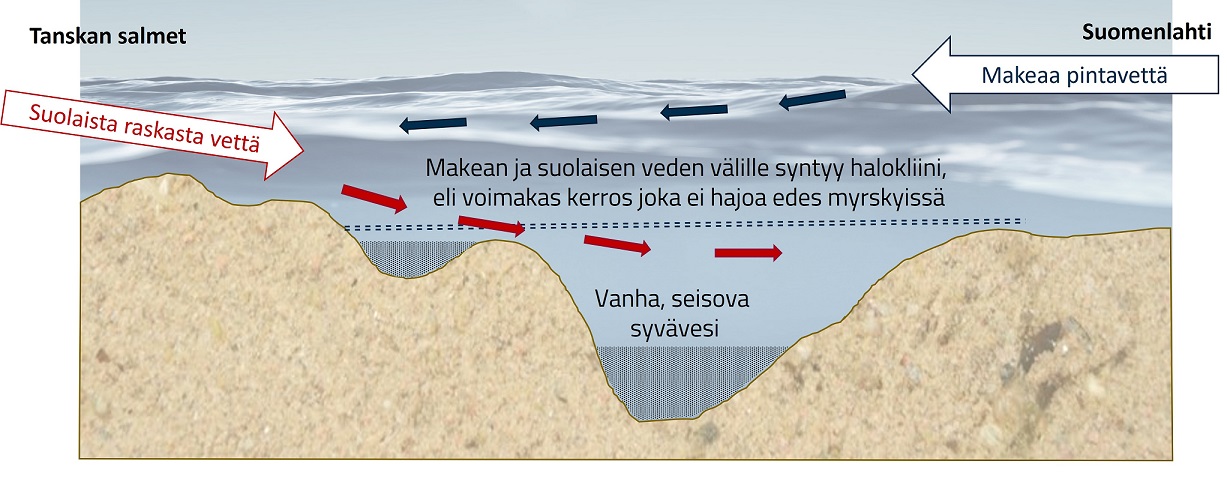
The Baltic Sea Proper has a permanent halocline at around 70 meters. The salinity stratification in different parts of Finland’s marine areas varies depending on how easily water from the central Baltic can flow into the region. The Bothnian Bay is very low in salinity and practically does not develop a halocline. In contrast, the Gulf of Finland occasionally forms a halocline when deep water from the central Baltic flows into its basins.
Water stratification affects the oxygen levels near the seabed, as a strong halocline prevents oxygen-rich surface water from mixing with bottom water. Organic matter sinking to the seabed can consume all available oxygen during decomposition if no new oxygenated water flows into the area.
Sisältö vaatii markkinointievästeiden sallimisen. Ole hyvä ja salli evästeet katsoaksesi sen.