Buy sparingly and use for a long time

Consider what products you buy
- Buy less and consider what you truly need
- Favor ecologically sustainable, repairable, and recyclable goods
- Choose products with environmental labels: The Nordic Swan is the official ecolabel used in the Nordic countries
- Buy products second-hand if you can
- Use items to the end and recycle appropriately
- Avoid purchasing mixed textiles
- Avoid overpackaged products and plastic packaging
why?
Consumer choices and interest in environmental issues challenge product design, businesses, and retail to better address environmental concerns.
Synthetic fibers, like conventional plastic, are made from fossil oil. By avoiding unnecessary consumption and favoring products with environmental labels, you reduce the amount of waste generated, as well as the amount of litter, harmful substances, and microdebris ending up in the sea. Textile materials made from blended fibers cannot be recycled.
The Nordic Swan label ensures that a product meets specific environmental criteria and contributes less to water eutrophication than many other products.
Avoid disposable items
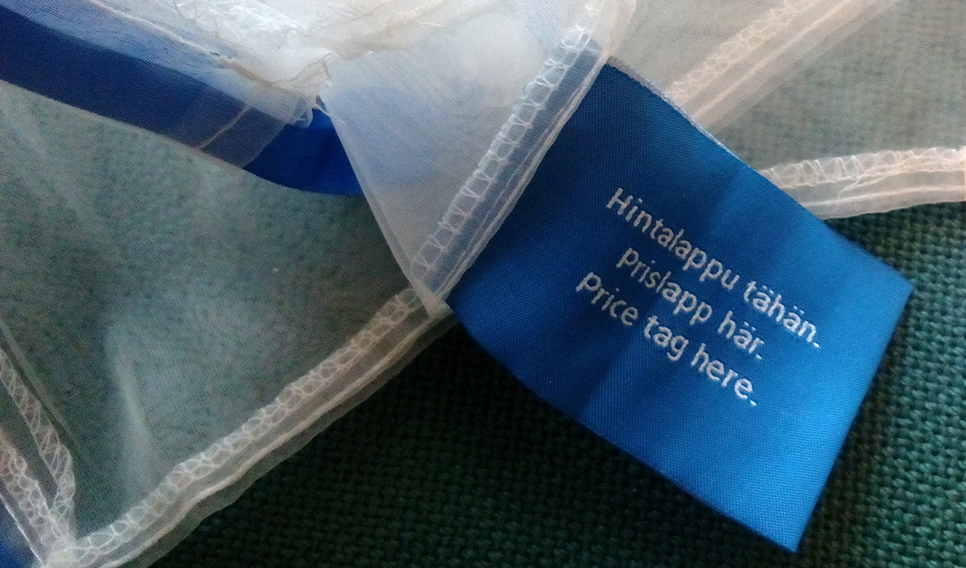
- Avoid using plastic bags: carry a durable shopping bag or transport your purchases in a backpack
- Carry reusable produce bags with you as well. (They are available in most grocery stores)
- Carry a reusable cup and use it for your drink instead of a disposable one
- Avoid using plastic cutlery
- Do not use plastic straws
why?
You reduce the amount of waste and littering of nature and waterways – while also conserving natural resources.
The most common type of litter in the Baltic Sea is cigarette butts. They are followed by various plastic waste, rubber, paper, glass, metal, and ceramics. Litter accumulates on shores or ends up in the stomachs of animals. As a result, harmful chemicals and heavy metals may eventually find their way into humans as well.
Consider what you eat
- Favor local food and seasonal produce
- Choose organic food
- Prefer vegetarian meals and reduce meat consumption
- Consider whether it’s worth buying farmed fish. Favor domestic options!
- Choose sustainably caught wild fish from the Baltic Sea, such as domestic bream, Baltic herring, perch, and pike, as well as MSC-certified fish. Check WWF’s fish guide (in Finnish).
why?
Greenhouse cultivation during winter and long transport distances place unnecessary strain on the environment. Organic food production does not use artificial fertilizers or pesticides, which means less burden on waterways.
Growing feed for livestock requires more fields, fertilizers, and pesticides than growing crops directly for human consumption. By favoring plant-based food, fewer nutrients and harmful substances end up in the sea.
Ecologically and sustainably caught fish means that fishing does not threaten fish populations.
When fish are removed from the water, nutrients are taken out with them. Therefore, eating wild fish that have grown in the Baltic Sea reduces the nutrient load in the sea. In addition to familiar food fish like perch and Baltic herring, bream species have also gained popularity at the dinner table, making them an excellent choice for the wellbeing of the Baltic Sea.
Fish farming in the sea increases nutrient levels, especially if nutrient recycling is not properly managed. However, fish farming methods and technologies have advanced significantly in recent years, and today domestic fish farming is considered to cause fewer nutrient emissions into the Baltic Sea than, for example, meat production.