The deep seafloor – there is also life in the darkness
The light or photic zone of the Baltic Sea extends to 20 metres at best, after which darkness begins to become the permanent state. As the depth increases, the species composition changes and eventually the last plants and algae that require sunlight to photosynthesize disappear. They are replaced by various invertebrate animals.
Bay barnacle
The bay barnacle, i.e. Amphibalanus improvisus, entered the Baltic Sea as early as the beginning of the 19th century. It is the only cirripede crustacean living on the Finnish coast. The actual animal hides inside a calcareous shell made of multiple segments. Barnacles are not found in the Bay of Bothnia because the seawater there is not salty enough for them to survive.
Monoporeia affinis (Fin. valkokatka)
The benthic amphipod, i.e. Monoporeia affinis, occurs all along the Finnish coast. It eats phytoplankton that have sunk to the bottom of the sea. Up to 10,000 individuals can be found scurrying around in a single square metre of the seabed. However, this species suffers from the deoxygenation of the seafloor caused by eutrophication.
Saduria entomon (Fin. kilkki)
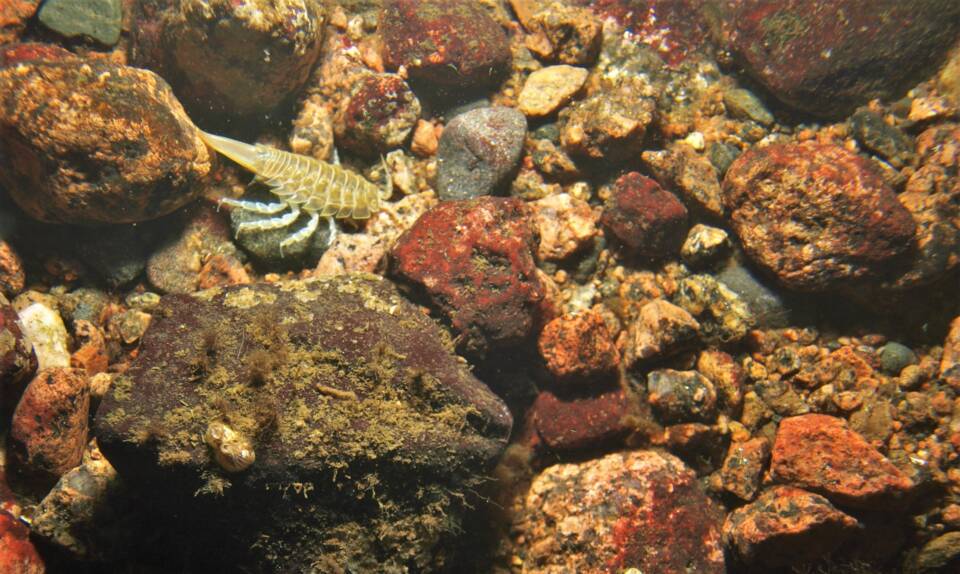
Saduria entomon is a large bottom-dwelling isopod crustacean that can grow up to 10 cm in length. These large isopods eat carrion and prey on both smaller amphipod crustaceans and bivalve molluscs, such as the Baltic tellin (Limecola balthica). Saduria thrives in cool water, thus during summertime, they remain on the deep seabed. They also prefer a dim or dark habitat.
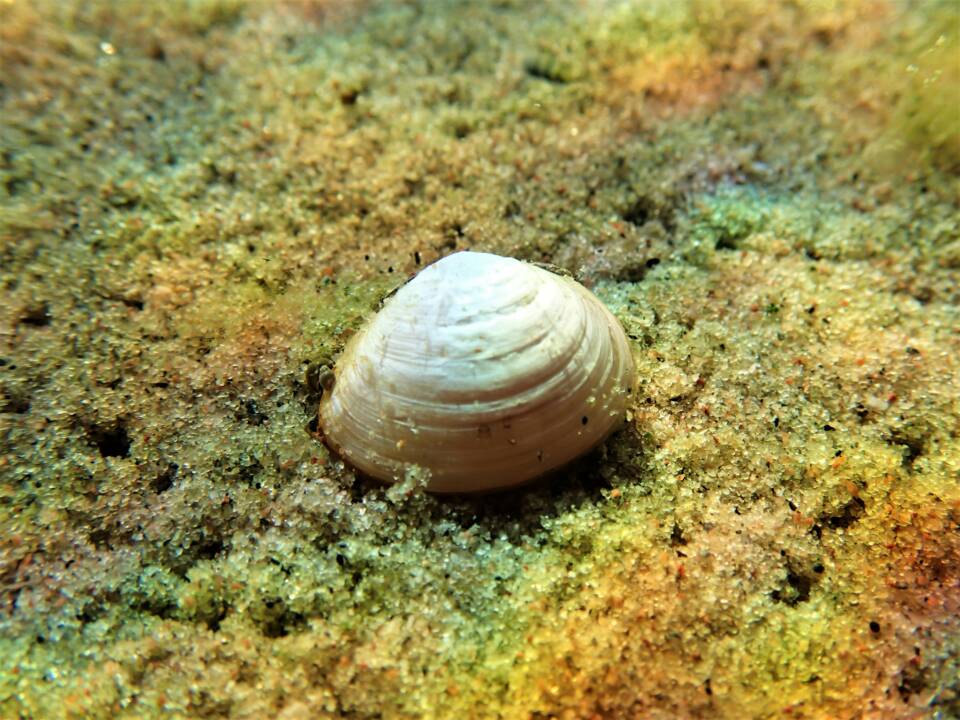
Baltic tellin
The Baltic tellin, i.e. Limecola balthica, is the most widespread species of bivalve mollusc in the Baltic Sea. It thrives in all sorts of soft bottoms. The larvae of this species are particularly suitable as food for both herring and benthic isopods.
At first glance, the seafloor resting in the depths of the Baltic Sea looks as deserted as the surface of the moon. There are no plants or algae in sight, and the landscape seems frozen in darkness and silence.
Humans could not survive in such an environment, but many small animals are perfectly at home there. Some species live buried in the seabed, while others crawl across its surface or swim just above it. Some spend their entire lives attached to stones or rock faces.
There is a constant struggle for food. The food web in the depths is based on the organic matter that sinks to the seafloor from the upper water layers. Mussels and many other animals feed by filtering tiny particles suspended in the water. Predators and scavengers are also abundant.
The bottom sediment of deep basins are full of life
The animal life of the deep bottoms is fairly similar along much of the coast. In the deep basins of open sea areas, the most common species are the amphipod crustaceans Monoporeia affinis and Pontoporeia femorata. These centimetre long crustaceans can occur in huge numbers — as many as 10,000 individuals per square metre. As they burrow through the seabed, they efficiently oxygenate the surface sediment. From time to time, they sprint into the water to move to a new location.
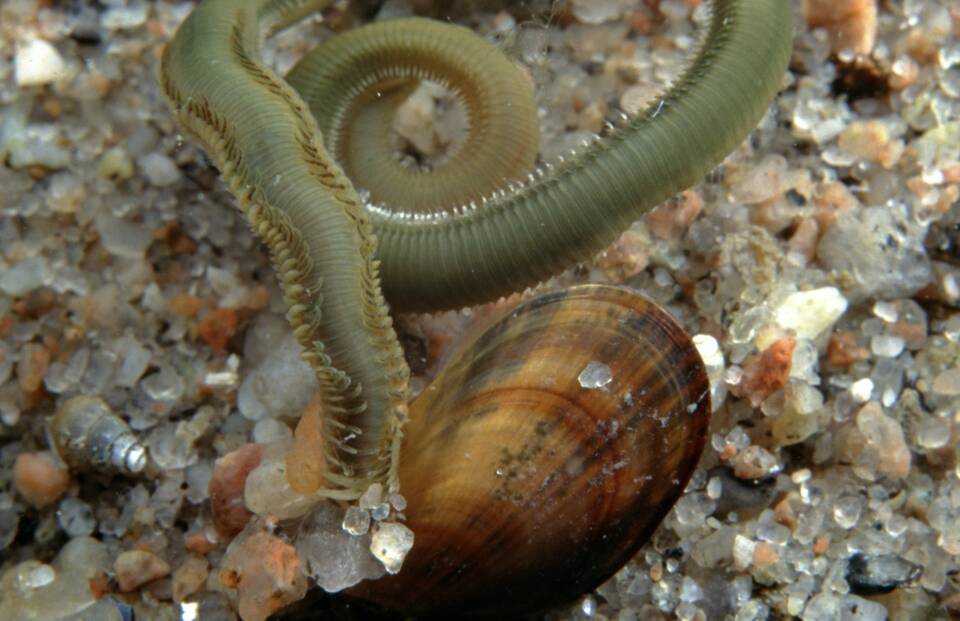
The amphipods are preyed on by many small predators, including polychaete worms and especially the scale worm which is particularly well adapted to hunting crustaceans. Another very common inhabitant of soft bottoms is the priapulid worm, a couple of centimetres long smooth-bodied animal whose appearance has often been compared to a small cocktail sausage. Only the proboscis of the worm, armed with sabre-like teeth, can be seen protruding the sediment,
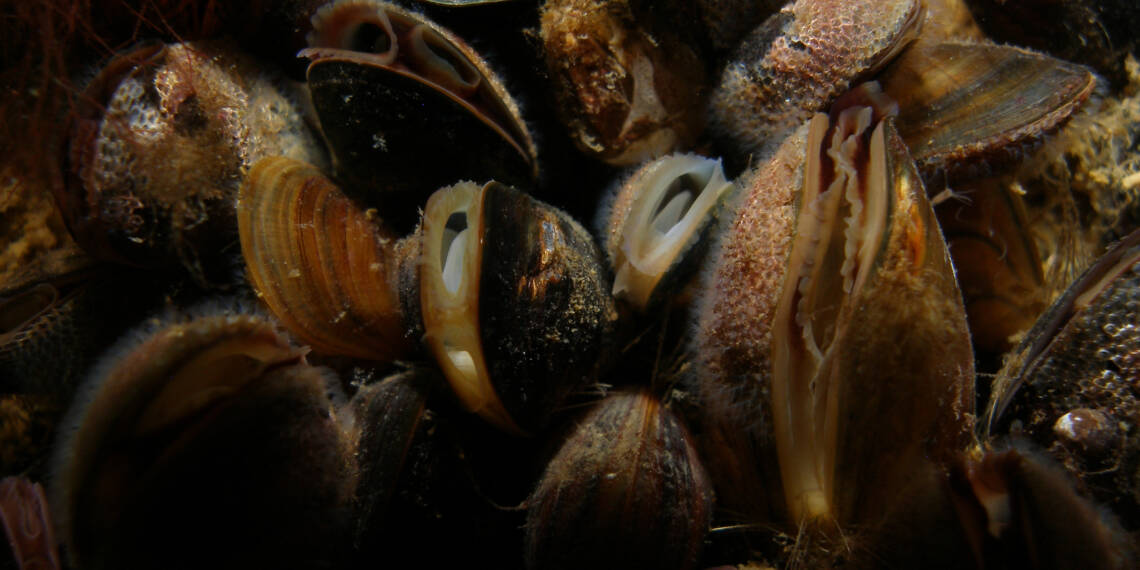
Larger animals include the sessile Baltic tellin, as well as the isopod, which creeps across the seabed. This predator can grow up to ten centimetres long and also feeds readily on carcasses that sink to the bottom. Common species found on stones and rock surfaces include the blue mussel, bay barnacle, encrusting bryozoan, and various polyps.
Species of the deep bottoms.
The large isopod, i.e. Saduria entomon, is a carrion eater living on the deep seafloor.
Species of the deep bottoms
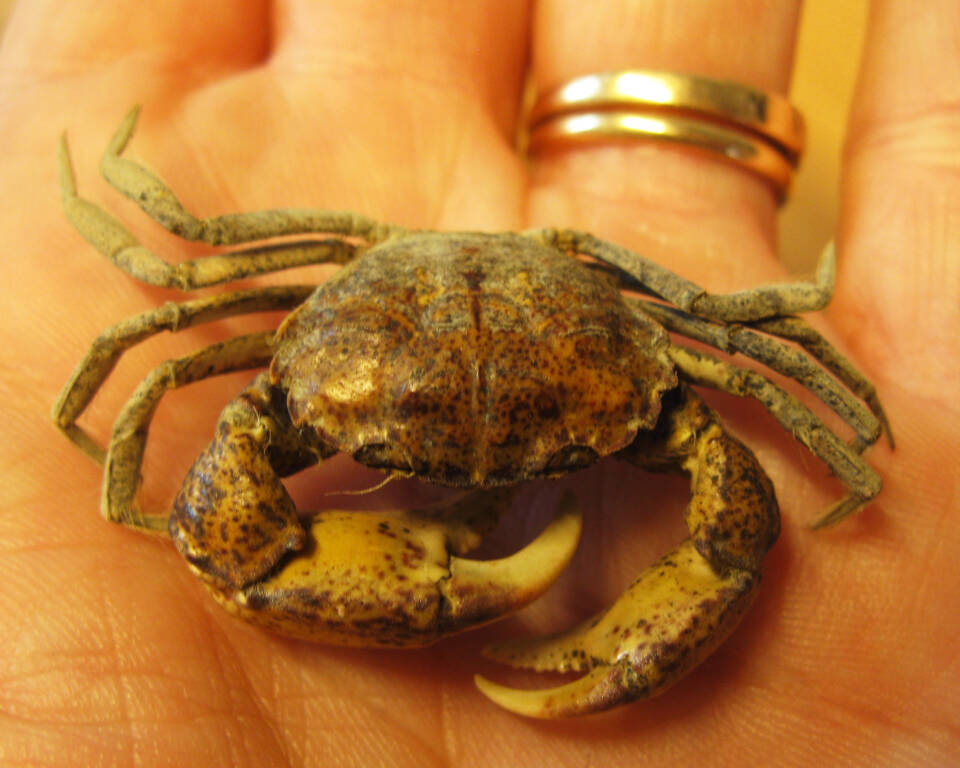
The Zuiderzee mud crab is an invasive species that has arrived in the Baltic Sea from North America
Species of the deep bottoms
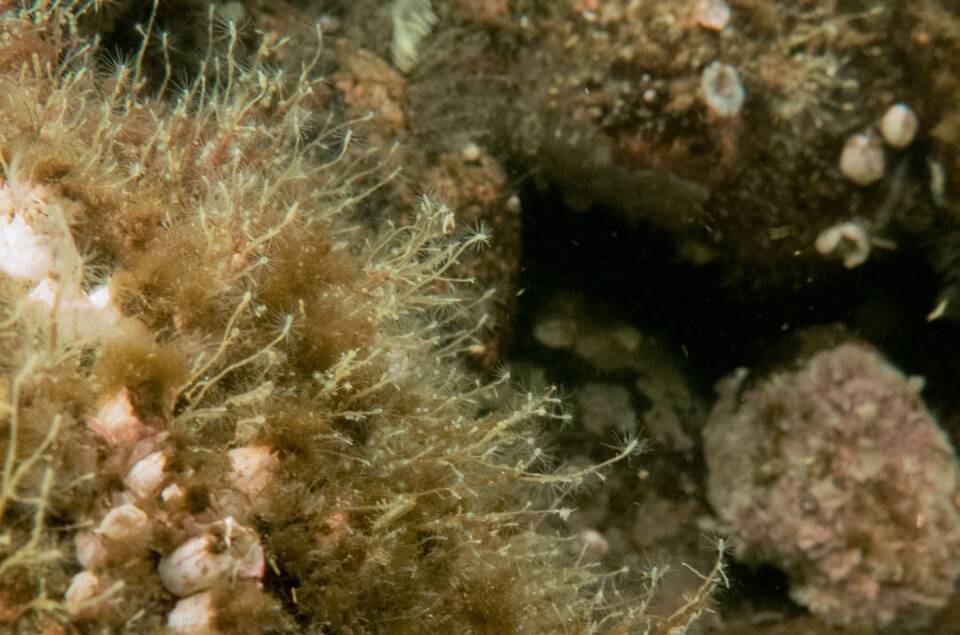
The Caspian polyp forms large plant-like colonies.
In the low-salinity waters of the Bothnian Bay, sponges and the polyp Cordylophora caspia are the most important filter feeders in deeper waters. In another relatively low-salinity sea area, the eastern Gulf of Finland, the bay barnacle is also found alongside them.
Today, the Zebra mussel can also be encountered in the eastern Gulf of Finland. This striped mussel, which attaches itself to hard surfaces, originates from the Black Sea, the Caspian Sea, and the Sea of Azov region, from where it probably spread to the Baltic via canals and rivers. It was first recorded in Finland’s marine waters in 1995.
On the south-west coast, it is possible to come across another alien species, the Zuiderzee mud crab, which originates from North America. It arrived on the Finnish coast fairly recently — the first observation dates from 2008 — but it now appears to be increasing rapidly.
Red-gilled mud worms are also relatively recent arrivals. These polychaete worms, which can grow up to ten centimetres in length, occur in the Atlantic and Arctic oceans, but they have only been found in Finland’s marine waters since the 1990s. Since then, they have spread along the entire Finnish coast. They dig deep burrows into the sea’s soft bottom sediments in both sheltered and open areas.
Red-gilled mud worms thrive deep into the bottom sediment and oxygenate the seabed as they churn it.
Visa Hietalahti
Anoxia and accumulating sediment makes life difficult on the seabed
Eutrophication and anoxia in the deep basins threaten benthic communities. Eutrophication increases the amount of organic matter sinking to the bottom, which in turn accelerates oxygen-consuming decomposition. When oxygen is depleted at the seabed, further problems follow: phosphorus that had previously been stored in the bottom sediment begins to be released back into the water, intensifying eutrophication even more. This process is known as internal loading.
Oxygen depletion on the seafloor is particularly severe in the Gulf of Finland and the Archipelago Sea. Oxygen-depleted bottoms have also been found in the Bothnian Sea in the recent years.
Animals living in the deep bottoms vary in how well they tolerate oxygen depletion: for example Monoporeia affinis and Pontoporeia femorata tolerates it poorly, whereas the priapulid worm and red-gilled mud worms cope better. Even so, prolonged anoxia will eventually wipe out even the most tolerant benthic animals.
Amphipods and many other species living in soft sediments play an important role in the health of the sea. They dig up the bottom material and bring oxygen into the surface layers of the sediment. This way they increase phosphorus binding in the sediment and help reduce eutrophication in the area.
Communities living on stones and rocky bottoms face different challenges. In eutrophic waters, many kinds of particles sink to the bottom, and as they accumulate they suffocate adult organisms. They also create a layer of sludge on the seabed, preventing the larvae of invertebrate animals from attaching to hard surfaces.
Organic material sinking from the surface to the bottom affects deep-sea communities.
Jussi-Tapani Roininen, Parks & Wildlife Finland
Did you know?
With their sensitive bulging eyes, mysid shrimps hate the light so much that they only leave the dark depths in the black of night.