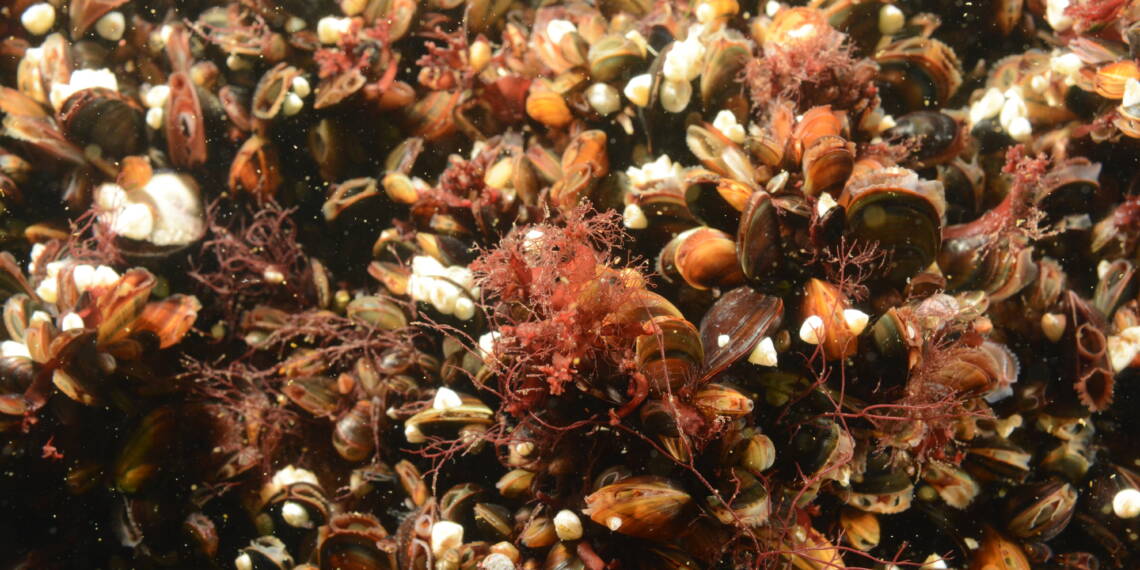
Benthic animals live on both hard and soft bottoms
Benthic fauna includes those invertebrate animals that spend most of their life cycle on the seafloor. Many benthic animals spend their entire lives buried in the soft seabed. Others mostly move around on top of the bottom or climb on aquatic plants. Some attach themselves to rocks or other hard bottom surfaces and stay fixed in place.
The extensive range of benthic animals includes species from several different groups. The species composition of benthic fauna changes according to the local environmental conditions. The community is mainly determined by the seafloor structure, depth, and salinity, as well as the openness of the shoreline.
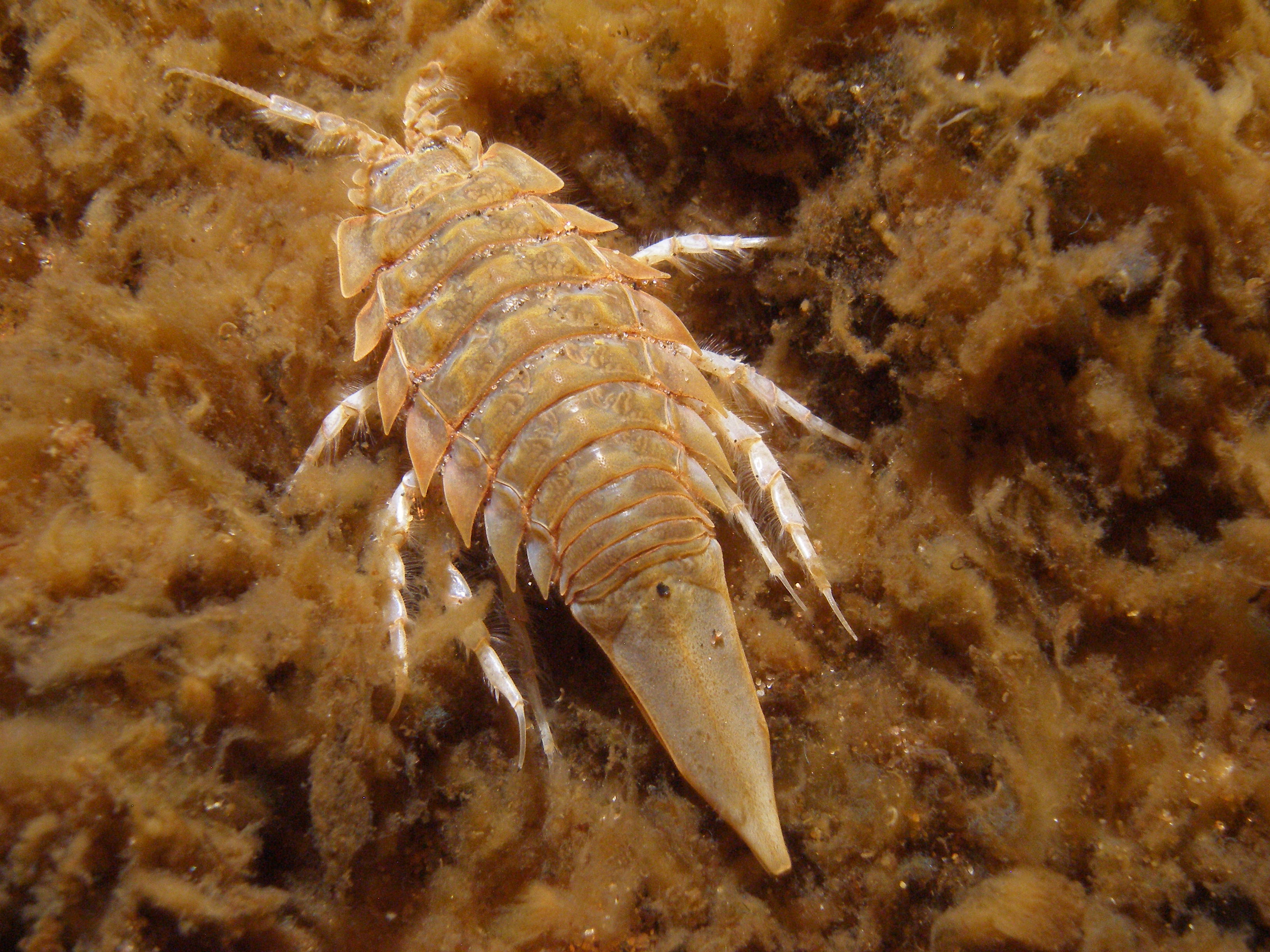
The isopod Saduria entomon is the largest crustacean on the Finnish shores
Although most benthic animals are quite small, they can still be detected easily with the naked eye. One of the largest benthic invertebrates on the Finnish shores is the benthic isopod species, i.e. Saduria entomon, which may grow up to ten centimetres in length. In Finnish it is called a “kilkki”. Like many other benthic fauna, these large isopod crustaceans spend a part of their life either digging in or crawling around on the seafloor and occasionally they also feed in the water column.
Other benthic fauna that occur alongside Saduria in the Baltic Sea include amphipods, prawns, mysid shrimps, oligo- and polychaete worms, and of course, various species of clams and snails.
In shallow areas, various aquatic insects also thrive in benthic faunal communities, such as caddis-fly and dragonfly larvae, whose aquatic phase is usually longer than their adult flying stage.
Observations of Baltic water-plantain in Finnish coastal areas starting from 2000. The map is based on observations recorded in Laji.fi portal that have a coordinate accuracy of 1 meter.
Macroplea pubipennis is a coastal specialty of Finland
-
 Find out more
The EU Nature and Birds Directives
Adult beetles can also be seen in coastal waters. The most common are diving beetles, which hunt underwater but surface to breathe. They can also take flight to move to a new habitat.
Rarer beetles include diving beetles that live on the seabed. They cannot swim at all and spend their entire lives underwater, usually in shallow coastal areas where they crawl among submerged plants or climb on plant shoots.
There are three species of diving beetles in Finland, with Macroplea pubipennis deserving special attention. It is globally rare and has not been observed anywhere else in Europe except in the northern Baltic Sea – and even there only along Finland’s coastline and, more recently, on the Swedish side of the Bothnian Bay. M. pubipennis is protected under the EU Habitats Directive, and Finland has a special responsibility for its conservation.
Observations of Macroplea pubipennis in Finnish coastal areas starting from 1980. The map is based on observations recorded in Laji.fi portal that have a coordinate accuracy of 10 meters.
The benthic faunal community of the soft seafloor is diverse
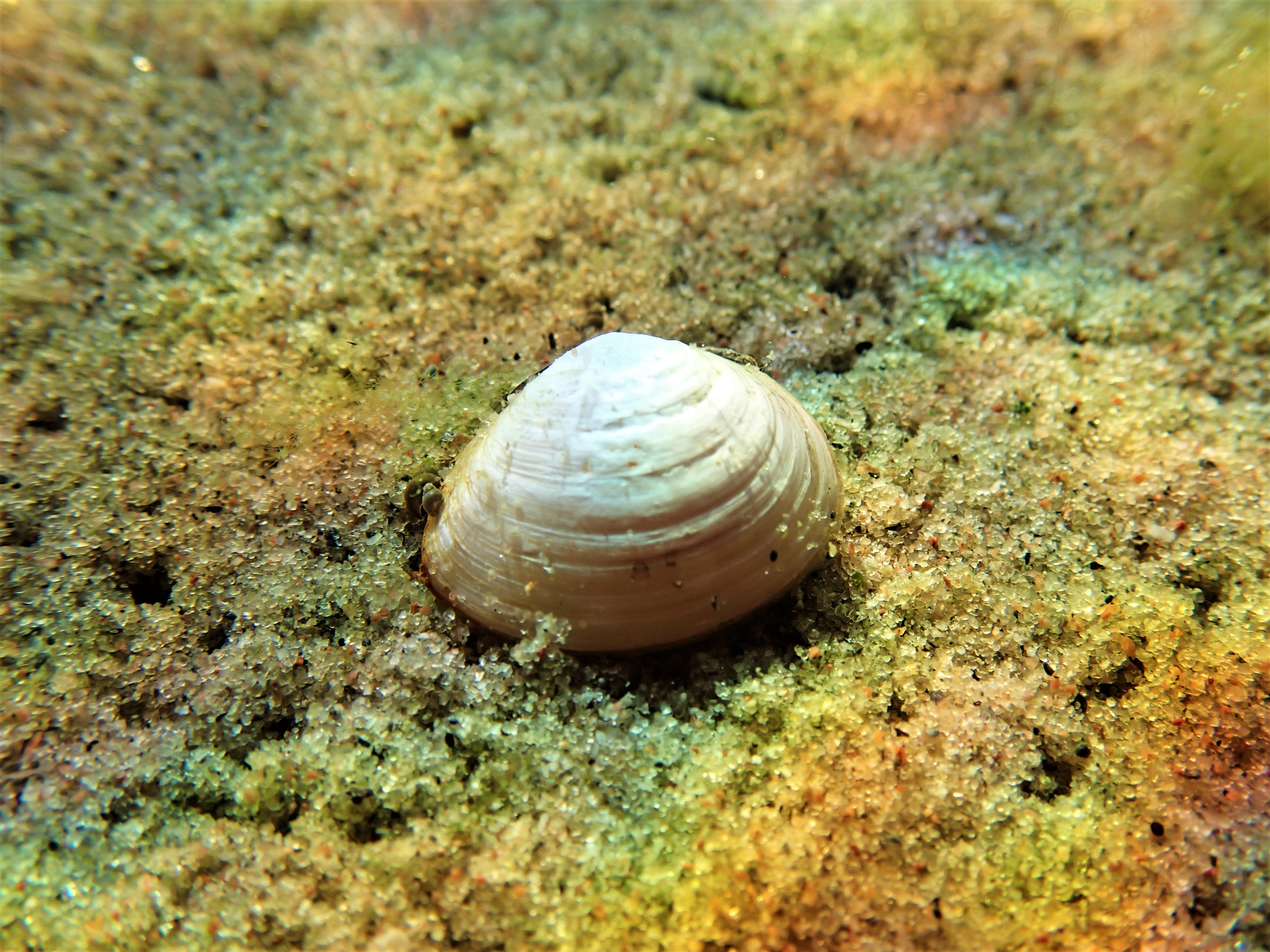
Many different species, such as clams, snails, crustaceans, oligo- and polychaete worms, as well as priapulid worms inhabit the sediments of the soft seafloor. Some of the largest of these species are the bivalve clams. The most common clam species found along almost the entire Finnish coastline are the so-called Baltic tellin and the sand-gaper. The former thrives in muddy sediments while the latter prefers somewhat coarser bottom deposits with a higher sand content.
Worms and amphipod crustaceans crawl about in the soft
bottom deposits
Various species of marine annelid worms crawl about in the soft bottom sediments alongside the clams. One group is the oligochaete worms, which are the aquatic cousins of the terrestrial earthworm. Oligochaete worms are pale, transparent and quite fragile. These worms get their name from their relatively few stiff bristles or chaetae, which protrude from their bodies and allow them to crawl through the sediments.
-
 Find out more
Deep bottoms
Among the oligochaete worms and clams are also found the polychaete worms, which somewhat resemble terrestrial millipede insects. Unlike oligochaetes, polychaetes can have multiple bristles per segment along the entire length of their bodies and often also have tentacles arranged around their heads. Polychaetes prey on other benthic fauna smaller than themselves either within the sediment or in the water currents immediately above the bottom. The largest species of polychaete in Finnish waters is the ragworm, i.e. Hediste diversicolor, which can reach up to 20 centimetres in length.
The amphipod crustacean species, i.e. Monoporeia affinis and the red-eyed Pontoporeia femorata are the hardest-working of the benthic fauna as they scurry about their tasks. These tiny crustaceans live in the surface layers of the bottom sediments, only a few centimetres below the sediment-water interface. They occasionally also venture out to the water above to feed.
A wide variety of benthic fauna hides on hard bottoms
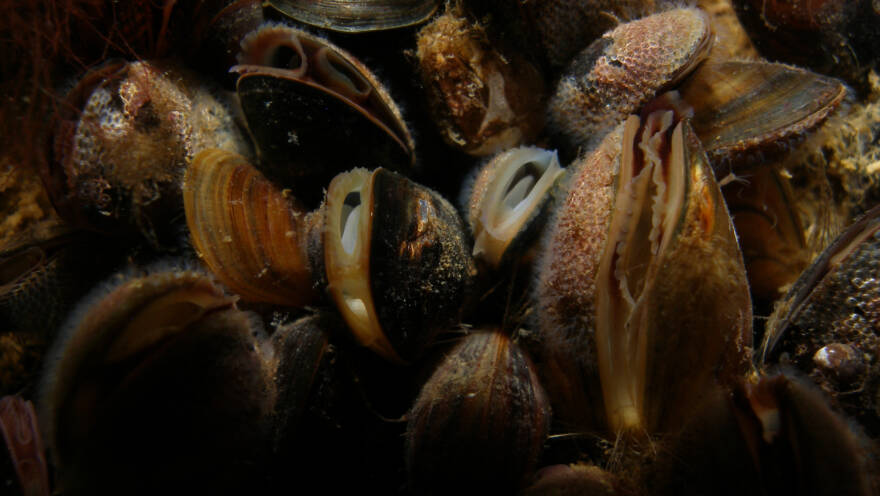
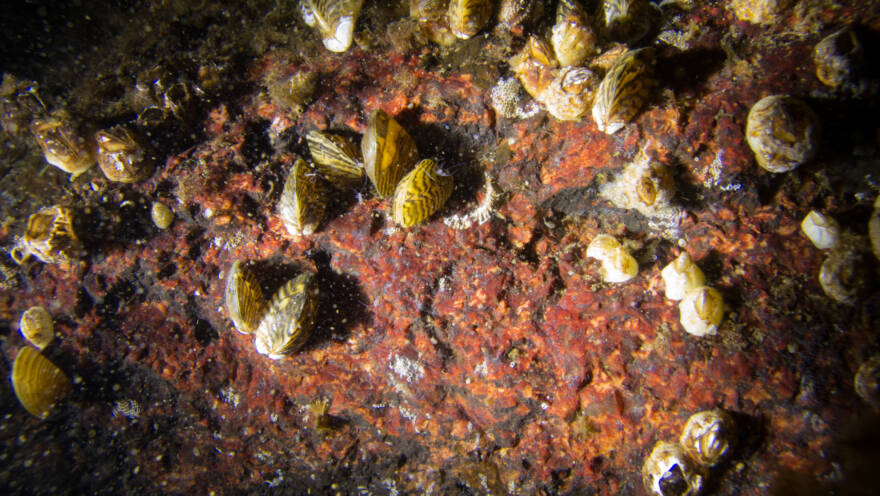
A wide variety of benthic animals can be found living on hard bottom types, such as rock, boulders and stones. Some species attach themselves directly to the hard substrate, while others require the protection of seaweeds. The most visible are the blue mussels, which grow up to several centimetres in length and are the most common in the outer reaches of the archipelagos on the southwest coast of Finland.
In terms of visibility, at the other end of the scale are the polyps, whose transparent colonies are easy to miss among the growths of filamentous algae. Both polyps and blue mussels alike grow attached on the hard substrate and cannot dart away from observers or predators.
Snails, gammarid amphipods and sea slugs graze on mats of diatoms that have accumulated on seaweeds growing on the hard substrate. These benthic animals can be easily seen just by slightly moving the mass of seaweed.
-

Blue mussels actively filter nutrients from the water. © Heidi Arponen, Metsähallitus -
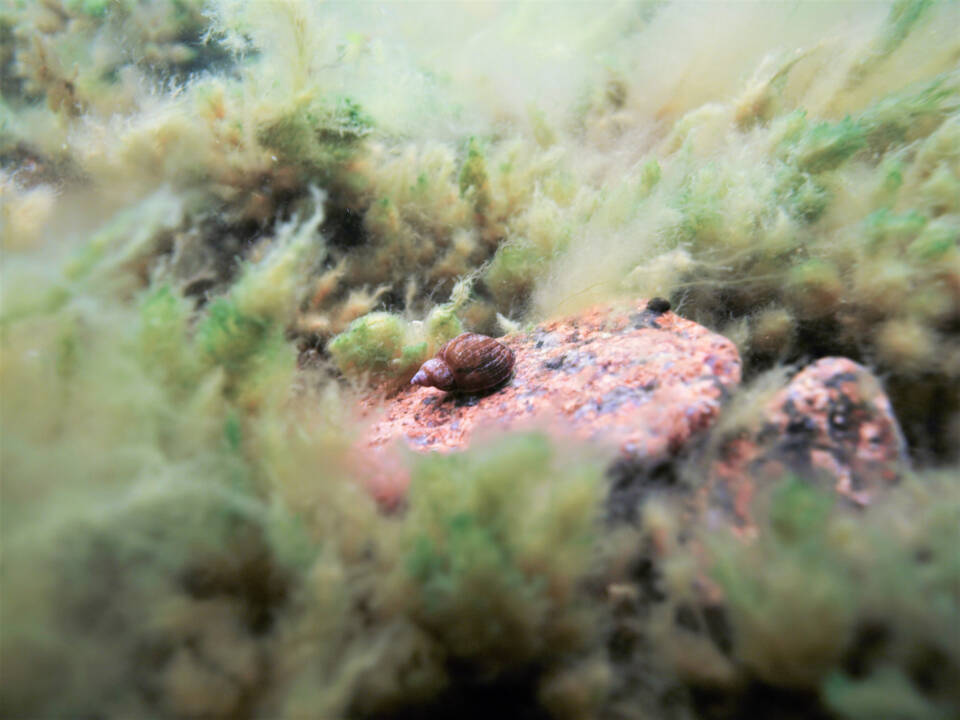
The pond snail lives in the low-salinity coastal waters of the Baltic Sea. © Maiju Lanki -
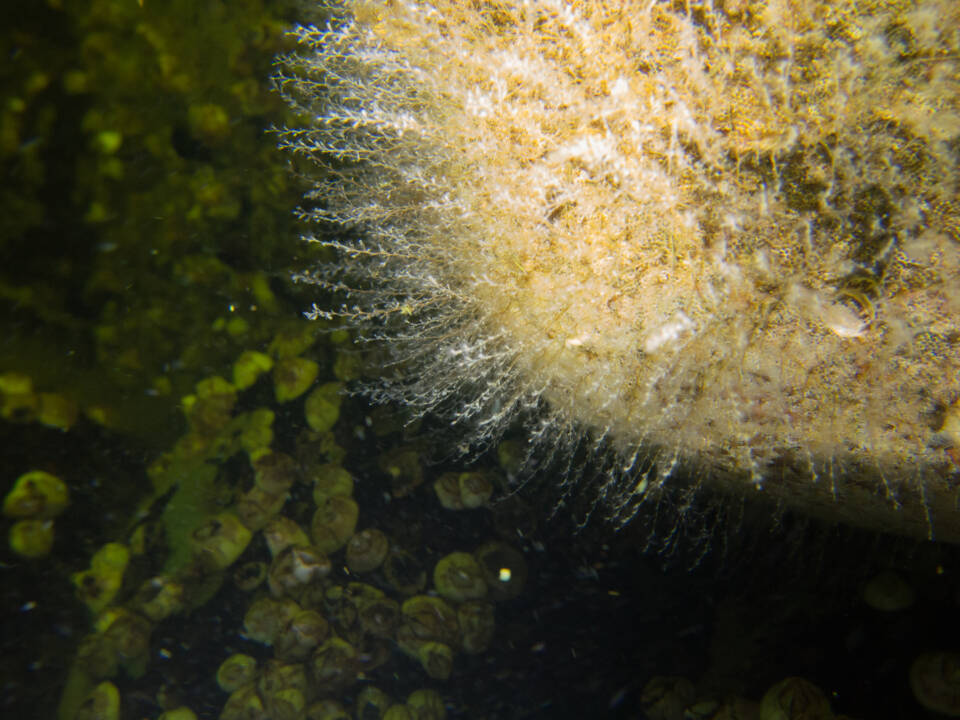
Laomedea loveni is a small cnidarian. © Petra Pohjola
Did you know?
Oligochaete worms that live in the soft seafloor sediments belong to the same group as terrestrial earthworms. However, the marine worms are a little paler and more fragile.
Benthic fauna:
- Benthic isopod crustacean (Saduria entomon)
- Mud shrimp/amphipod (Corophium volutator)
- Baltic tellin (Macoma balthica)
- Sand-gaper clam (Mya arenaria)
- Duck mussel (Anodonta anatina)
- Oligochaetes (Oligochaeta)
- Ragworm (Hediste diversicolor)
- Red-gilled mudworm (Marenzelleria spp.)
- Amphipod crustaceans (Monoporeia affinis, Pontoporeia femorata)
- Marine Leaf beetle (Macroplea spp.)
- Blue mussel (Mytilus trossulus)
- Polyps (Cordylophora caspia, Laomedea loveni)
- Gammarid amphipods (Gammarus spp.)
- Herbivorous isopods (Idotea spp.)
- Brackish water sponge (Ephydatia fluviatilis)
- Encrusting bryozoan (Electra crustulenta)
- River nerite snail (Theodoxus fluviatilis)
- Hydrobid mud snails (Hydrobiidae)
- Broad-headed lanceolate slug (Limapontia capitata)
-
 Find out more
Alien species
-
 Find out more
Water quality and marine litter