Maritime Policy Promotes Sustainable Use of the Sea and Global Influence
Finland’s maritime policy seeks to ensure the sustainable use of the sea and its natural resources, while safeguarding the good status of the marine environment. The cornerstones of an active and globally influential maritime policy are Finland’s strong maritime expertise, its innovative maritime cluster, and safe and environmentally responsible maritime logistics.
The sea is a shared resource and a source of livelihoods for humankind. It covers more than 70 per cent of the Earth’s surface. Two thirds of the surface area of the global ocean lies beyond national jurisdiction and belongs to the common heritage of all nations. Humanity shares a responsibility for all marine areas and for the protection of the marine environment. The seas also offer significant opportunities for sustainable blue growth.
Marine environments are facing growing pressures. Climate change is warming and acidifying the oceans, overfishing is threatening fish stocks, and marine litter is endangering the wellbeing of marine organisms. Many marine areas are also affected by biodiversity loss, recurring oil and chemical spills, and eutrophication, the excessive growth of algae caused by nutrient enrichment.
Marine research provides the knowledge needed to support decision-making related to the oceans. Even so, much about the global ocean remains unknown. There is a continuing need to increase knowledge and understanding of the seas and the risks they face. This is one of the aims of the United Nations Decade of Ocean Science for Sustainable Development 2021–2030.
International Commitments Guide Maritime Policy
Sustainable blue growth and reducing the pressures on marine environments require a long-term maritime policy. Building on its strong maritime expertise, Finland is particularly well placed to develop and implement a forward-looking and solution-oriented maritime policy.
Finland’s maritime policy is influenced by a range of international programmes and agreements. These include, in particular, the United Nations Convention on the Law of the Sea (UNCLOS) and the UN 2030 Agenda for Sustainable Development. UNCLOS establishes the international framework governing the use of the oceans, their natural resources and other marine activities. The 2030 Agenda sets out shared sustainable development goals for all countries of the world.
Finland is also committed to the global biodiversity framework adopted at the United Nations Biodiversity Conference in Montreal in 2022. Under the agreement, 30 per cent of the world’s land and marine areas are to be protected, and one third of degraded ecosystems restored by 2030.
As most of the world’s marine areas lie beyond national jurisdiction, a new agreement under the United Nations Convention on the Law of the Sea was adopted in 2023. Known as the Agreement on Biodiversity Beyond National Jurisdiction (BBNJ), it enables measures to protect biodiversity in areas beyond national jurisdiction and strengthens the conservation and sustainable use of marine life on the high seas.
EU Maritime Policy Supports the Sustainable Use of the Oceans
The European Union’s maritime policy aims to support the sustainable use of the oceans. One of the key instruments for achieving this goal is the EU Maritime Spatial Planning Directive (2014). The directive requires Member States to prepare strategic plans for their marine areas that take into account both environmental and human needs and help reconcile different uses of the sea.
To support the implementation of sustainable ocean use, the European Commission has introduced the Ocean Pact (2025), a comprehensive framework bringing together the EU’s maritime policies. The Ocean Pact is a broad ocean strategy that seeks to address marine challenges and strengthen Europe’s leadership in ocean governance. Its key principles include a land-to-sea approach, the precautionary principle, science-based decision-making and an ecosystem-based approach.
The Ocean Pact is built around six strategic objectives:
- Good environmental status of the oceans
- A competitive and sustainable blue economy
- Support for coastal regions and island communities
- Strengthening ocean knowledge and expertise
- Safe maritime transport and maritime security in the EU
- Promoting the EU’s ocean diplomacy
A Globally Influential Maritime Policy
The aim of Finland’s maritime policy is to ensure the sustainable use of the sea and safeguard the good status of the marine environment. In its maritime policy vision, Finland acts as a globally influential player and develops solutions that contribute to achieving these goals. Finland is well positioned to do so thanks to its strong maritime expertise, innovative and successful maritime cluster, and safe and environmentally responsible maritime logistics.
Through its maritime policy, Finland seeks to strengthen its influence on international decision-making related to ocean governance, marine protection and the sustainable use of marine resources. At the same time, the oceans are recognised as offering significant opportunities for economic growth and innovation in Finland.
Government Guidelines Define the Priorities of Maritime Policy
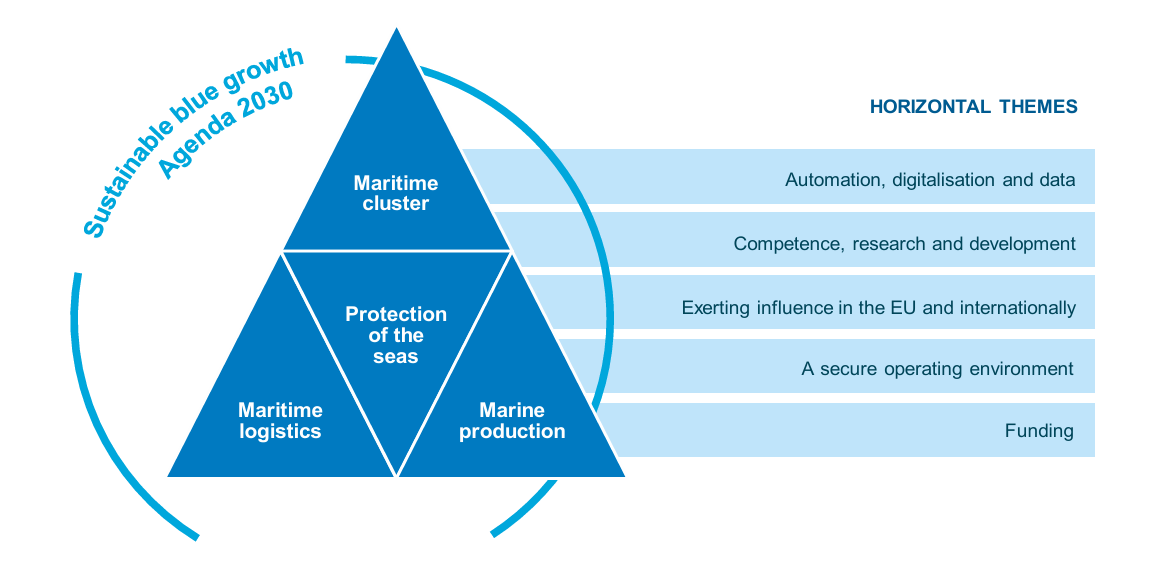
The priorities of Finland’s maritime policy were set out in a Government Resolution adopted in 2019. The resolution identifies four key priorities: the protection of the oceans, maritime logistics, the maritime cluster and marine production. These priorities are linked by a number of cross-cutting themes, including research and education, international influence, automation and digitalisation, and a safe operating environment.
Maritime Policy Priorities and Actions
The Maritime Policy Guidelines (2019) and the related Action Plan (2022) set out the policy’s more detailed objectives, or priorities, and the measures for achieving them. The priorities emphasise a safe and efficient operating environment, sustainable solutions and new innovations, as well as a global perspective. The measures range from improving technology and strengthening knowledge and expertise to international advocacy.
The priorities for ocean protection include halting or mitigating developments that threaten the marine environment, including climate change. The measures are based primarily on international advocacy. Finland seeks to strengthen the international legal framework for ocean protection and the implementation of international agreements. Finland also works to ensure that ocean protection and sustainable use are integrated into all policy areas dealing with maritime affairs. Other important priorities include developing marine research with a stronger global focus and promoting Finnish maritime expertise and solutions beyond the Baltic Sea region.
In maritime logistics, the aim is to promote safe, efficient and low-emission transport on the world’s oceans. The measures include ensuring smooth and reliable logistics under all conditions, developing the economic and administrative operating environment for logistics, and promoting digitalisation throughout logistics chains. The expertise of Finnish logistics operators will be strengthened, and the Baltic Sea will be developed into an international testing ground for autonomous shipping to support the advancement of maritime transport.
The development of the maritime cluster aims to create competitive and innovative solutions for global markets. The measures seek to influence the international conditions and rules of competition and to improve the operating environment of the maritime cluster. They support the renewal of the maritime cluster, the development of innovations and the use of global opportunities.
The priorities for marine production include globally sustainable aquaculture as part of the solution to the world’s food shortage, as well as the sustainable use of the sea for recreation and renewable energy production. The measures focus on developing production and services, identifying new biotechnological opportunities and creating joint solutions that serve multiple objectives. The aim is to develop efficient and environmentally sustainable production methods and technologies for global markets.