The Ocean Faces Change
The immense scale of the world’s oceans can easily create the impression that no human activity is capable of altering the sea or disrupting its timeless rhythms. This perception has proven to be false. In recent decades, the global ocean has undergone a wide range of changes, the consequences of which are increasingly reflected in human well-being.
People living along the coasts have travelled the seas and made use of their natural resources since time immemorial. Technological advances and the commercialisation of natural resource use have transformed these activities on an unprecedented scale. The pressures placed on the ocean have multiplied, and competition for its resources has intensified to the point where some of the ocean’s natural assets are now at risk of depletion.
Fish Stocks Suffer from Overfishing
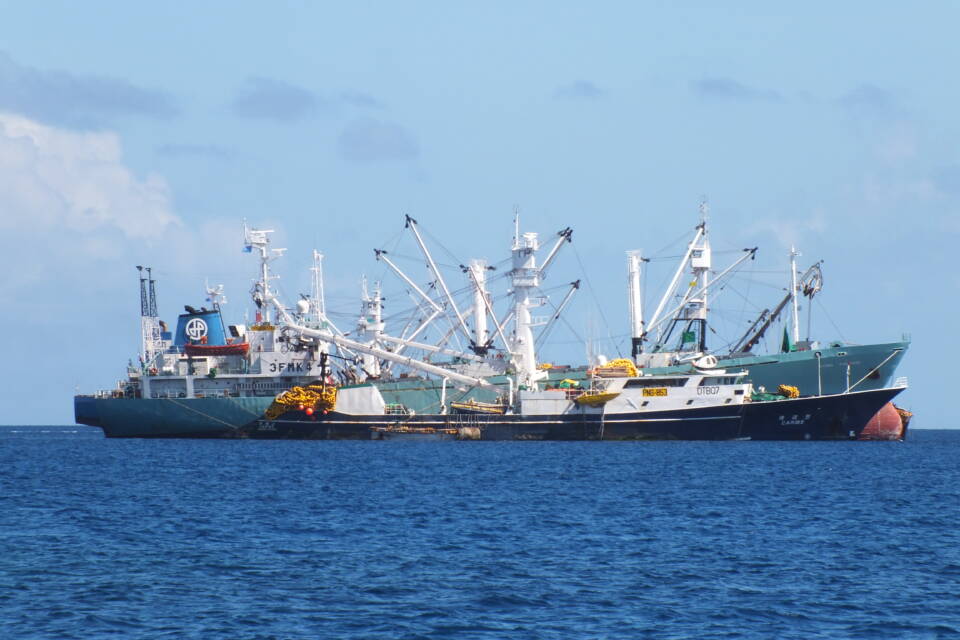
Unsustainable fishing practices and illegal fishing are global problems. Industrial-scale fishing fleets operate across vast areas of the open ocean and international waters. Bottom trawling scrapes the seafloor, damaging fragile marine habitats. Trawls also catch large amounts of bycatch, including fish of the wrong size and non-target species. Intensive trawling has been one of the factors contributing to the collapse of shark populations and many other predatory fish species.
According to the Food and Agriculture Organization of the United Nations (FAO), most marine fishing areas are fully exploited or overfished. In 2022, the global marine catch amounted to approximately 91 million tonnes. About half of this catch was landed by fleets from seven countries: China, Indonesia, Peru, Russia, the United States, India and Vietnam. The most important target species included anchoveta, Alaska pollock and skipjack tuna.
Small-scale fishers face growing challenges in many parts of the world. Fishing rights are often granted to large companies, while most of the catch is exported abroad. When overfishing continues for too long, even the strictest fishing restrictions may no longer be enough to restore depleted fish stocks.
The Deep Seafloor Holds Valuable Metals
Commercial seabed extraction, oil drilling and mining have traditionally been concentrated on continental shelves. This situation may change, however, as demand for the metals needed for the green transition continues to grow. Over millions of years, mineral-rich deposits have formed around hydrothermal vents along tectonic plate boundaries. These deposits contain valuable metals such as manganese, nickel, lithium and cobalt. The same metals are essential for modern technologies, including smartphones, batteries, wind turbines and solar panels.
So far, deep-sea mining activities have mainly been limited to exploration projects. However, several countries, particularly the United States, have also begun preparing for commercial mining operations. Mining robots lowered from ships to depths of several kilometres, along with ore-collecting machines and seabed dredging equipment, could dramatically alter the seafloor. There are concerns that these activities may damage or destroy marine communities, many of which remain largely unknown to science.
Coastal Waters Suffer from Eutrophication
Eutrophication, the excessive growth of algae caused by nutrient enrichment, affects coastal waters and marine areas on continental shelves in particular. These are the very areas that are most important to coastal communities and their livelihoods. Ocean currents and the shape of coastlines have a major influence on how susceptible different regions are to eutrophication. Semi-enclosed seas bordered by islands and peninsulas, especially those with densely populated coastlines, are the most vulnerable. Examples include the Baltic Sea as well as the archipelagos and coastal waters of Southeast Asia.
Marine areas prone to eutrophication are found along both shores of the North Atlantic, on the western rim of the Pacific Ocean and along the northern coast of the Indian Ocean. The Atlantic coast of South America also includes regions vulnerable to eutrophication. These same coastal areas often face additional pressures from chemical pollution and marine litter.
Garbage Patches Drift Across the Open Ocean
Millions of tonnes of waste enter the world’s oceans every year, and at least 85 per cent of it is plastic. Some of this plastic debris washes ashore, but a large share is carried far out to sea by winds and ocean currents. Estimates of the total amount of plastic accumulated in the oceans vary, but all point to a figure well over 100 million tonnes. The amount of plastic in the oceans is expected to double or even triple in the coming decades.
The scale of the ocean plastic problem became widely recognised in 1988, when a vast accumulation of floating debris was discovered in the Pacific Ocean. It later became clear that this garbage patch was far larger than initially thought, covering an area roughly four times the size of the Baltic Sea. The Great Pacific Garbage Patch has therefore been described as the world’s largest landfill. Similar large-scale accumulations of floating waste have since been identified in the North Atlantic as well.
Plastic waste poses a serious threat to marine life. Whales, seals, sea turtles, seabirds and fish may ingest plastic fragments or become entangled in them. Driven by ocean currents and broken down by waves, plastic gradually fragments into ever smaller pieces. These particles are consumed by invertebrates and even microscopic plankton, allowing plastic to enter marine food webs and spread throughout the ocean ecosystem.
Climate Change Is Visible in Marine Ecosystems
Climate change has warmed and acidified the oceans, and there are no signs that this trend is slowing down. These changes are having far-reaching effects on marine ecosystems, as many species are highly sensitive to the temperature and acidity of their environment.
According to findings published in 2025, the widespread loss of coral reefs from the world’s oceans is now considered almost certain and irreversible. The destruction of coral reefs would mean the permanent loss of one of the ocean’s most important and species-rich habitats. At that point, the world will have crossed its first climate-related tipping point, a threshold beyond which there is no return.
Warming Ocean Waters Fuel Tropical Cyclones
Tropical cyclones occur in regions near the Equator where sea surface temperatures reach at least 26°C. The air above the warm water heats up and rises rapidly, creating an area of low pressure. At the same time, large amounts of water evaporate from the ocean surface. As the water vapour rises, it condenses into clouds and eventually falls as heavy rain. When water vapour condenses, vast amounts of energy are released, fuelling the development and intensification of tropical cyclones.
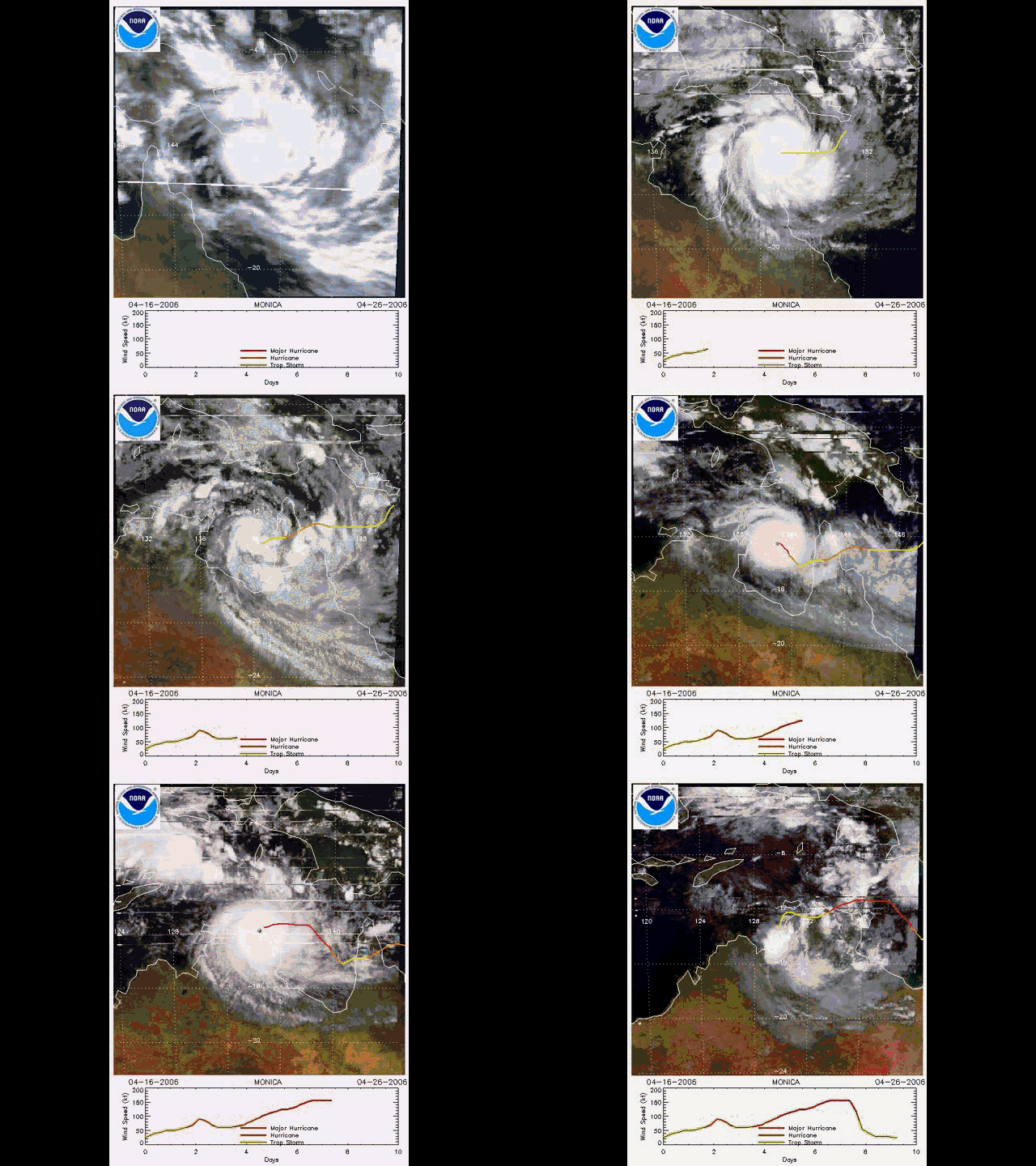
Climate change is expected to strengthen tropical cyclones and increase the intensity of heavy rainfall. Low-pressure systems and powerful storm winds can cause sea levels to rise rapidly along coastlines, generating destructive storm surges. In the Pacific region, typhoons occur throughout the year, whereas in other regions their occurrence is limited to certain seasons due to the cooling of seawater during winter and the seasonal patterns of the trade winds. Coastal ecosystems, such as mangrove forests and coral reefs, help protect shorelines from storm waves, flooding and erosion.
Rising Sea Levels
As seawater warms, it expands, causing sea levels to rise. This process is further accelerated by the melting of continental ice sheets and glaciers, which add more water to the oceans. Since the early 1990s, global sea level has risen by an average of just over three millimetres per year, amounting to about ten centimetres so far. Roughly half of this rise has been caused by the thermal expansion of seawater and half by the melting of land-based ice.
Sea level is expected to continue rising throughout this century. By 2100, global sea level could be around half a metre to one metre higher than it is today, depending on how successfully climate change can be mitigated. However, these projections remain uncertain because they are influenced by factors such as local temperatures and precipitation patterns in polar regions. Another important factor is how effectively ocean currents transport heat into deeper layers of the ocean.
Is the Gulf Stream Weakening?
One of the more recent concerns is the potential impact of climate change on ocean currents, particularly the Atlantic Meridional Overturning Circulation (AMOC), of which the Gulf Stream is a part. Fresh meltwater from the Greenland Ice Sheet could weaken the AMOC or even bring it to a complete halt.
In the worst-case scenario, the AMOC could begin to weaken once the global average temperature has risen by two degrees Celsius. If this were to happen, the climate of the Nordic countries would become colder, storms would become more frequent, and sea ice would cover larger areas during winter than it does today. In another scenario, the AMOC would not begin to weaken until global temperatures had increased by 3 to 4 degrees Celsius. In that case, the overall effect on temperatures in the Nordic region would be limited, as the warming caused by global climate change would offset the reduced heat transport of the Gulf Stream. However, regardless of which scenario unfolds, the challenges would not end there. Sea levels are expected to continue rising around the world, including in the Nordic countries.
-
 Find out more
The status of marine environment
-
 Find out more
What is ecological compensation?